Decisions locked (from the whiteboard)
- One size fits none. Blast the same message to your whole list and it lands for no one. A honeymooner, a family, and a past client need different words.
- ★ Why one size fits none (the headwind): this beats The Leaky Bucket. One undifferentiated pile leaves you silent or generic; irrelevance is a slow leak (people tune out and forget you). Relevance keeps names warm.
- ★ The tags that matter: four families cover almost everything, Stage (the 2.4 pipeline: New, Nurturing, Booked, Past client), Trip type (their niche/dream), Source (referral, social), and Timing (this year, someday).
- ★ Don't drown in tags: same lesson as 1.6. A few tags you apply every time beat fifty you abandon in a week. Consistent beats clever. Find the right group in three seconds.
- ★ Set them up in your CRM: create the short list once in a tool like Tern, then tag at intake, alongside the discovery notes. A list you'll tag later is a list you never tag.
- ★ Tags drive the follow-up (the payoff): tags are the switchboard. The honeymoon nurture goes only to honeymooners, the welcome-back only to past clients, the fast reply only to hot this-year leads. It feels personal, and it nearly runs itself.
- Second Mate (never Co-Pilot) suggests your tag set, sorts a messy backlog, and names the exact segment to message. Prompts in the library.
The spine — beat order
Not every lead is the same, so one message can't serve them all. Tag who someone is and what they want with a small, consistent set, set the tags up in your CRM and apply them at intake, and let those tags route the right follow-up to the right person. The right message reaches the right person.
- One size fits none
- Why one size fits none (the Leaky Bucket)
- The tags that matter (stage, trip type, source, timing)
- Don't drown in tags (a few, used well)
- Set them up in your CRM (tag at intake, in Tern)
- Tags drive the follow-up (the payoff)
- Segmentation (the diagram)
- Put your Second Mate to work
- Your first brick: build your tag set
- Want a hand? (the hook)
- Into 4.8, Working the Pipeline
The anchor diagram — segmentation
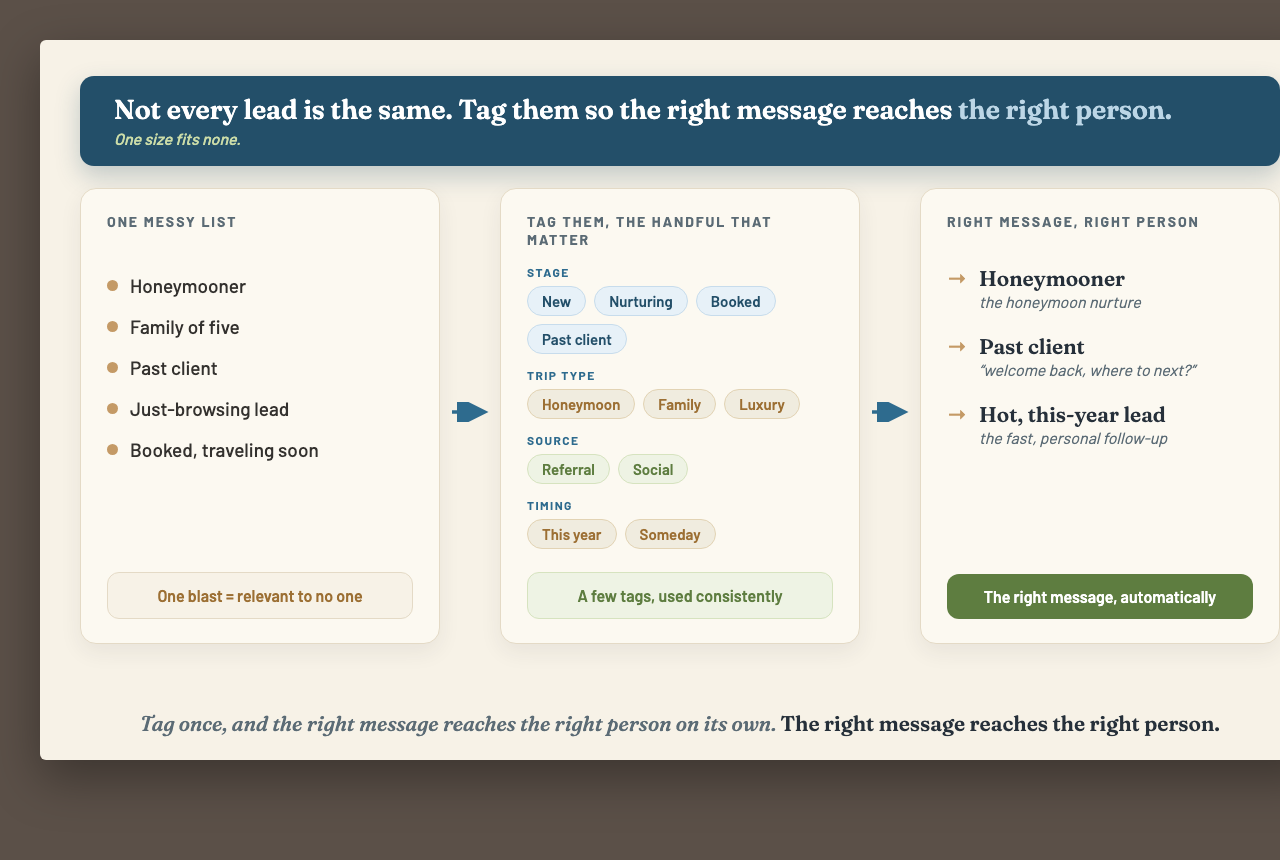
Tag once, and the right message reaches the right person on its own. The right message reaches the right person.
Your starter tag set — four families, a few each
| Family | Example tags | It answers |
|---|---|---|
| Stage | NewNurturingBookedPast client | Where they are in your pipeline (from 2.4) |
| Trip type | HoneymoonFamilyLuxury | What they want / their niche |
| Source | ReferralSocialNetworking | Where they came from |
| Timing | This yearSomeday | How hot, how soon |
The teaching script — Robert's voice
One size fits none
You have spent this whole section learning to bring people in and book them. Now we make sure nobody you worked so hard to capture slips out the back. And it starts with a simple truth: not every lead is the same. The honeymoon couple, the family of five planning spring break, the past client who traveled with you two years ago, they are completely different people with completely different needs. So when you send all of them the exact same message, you are not reaching everyone, you are reaching no one. One size fits none. The fix is to know who is who, and that is segmentation.
Why one size fits none
Think about what happens when every lead just sits in one big undifferentiated pile. You can really only do one of two things, and both of them leak. Option one, you go silent, because honestly, writing something for everyone all at once feels like writing for no one, so you freeze and send nothing. Option two, you send one generic blast that is mildly irrelevant to every single person on it. And here is the quiet danger: irrelevance is a slow leak. Nobody storms off. They just gently tune out, stop opening, drift, and forget you exist. Segmentation fixes this at the root, because once you tag who somebody is and what they want, you can finally talk to them like an individual. And relevance is exactly what keeps a name warm in your bucket instead of slowly seeping out the bottom.
The tags that matter
So what do you tag? You do not need many, just a handful of families that cover almost everything. First, stage, which is simply where they are in your pipeline, New, Nurturing, Booked, Past client, and you already built that back in your Manifest in session 2.4. Second, trip type, their niche or their dream, honeymoon, family, luxury, whatever kind of travel they are after. Third, source, where they came from, a referral, social, a networking event. And fourth, timing, are they traveling this year or just dreaming for someday. Where they are, what they want, where they came from, and when. Get those four down and you can slice your list any way you will ever need to.
Don't drown in tags
Now let me save you from the classic mistake, and it is the very same lesson as choosing your routes back in 1.6. People discover tagging, get a little drunk on the power of it, and create fifty hyper-specific tags they will never, ever actually use, and the whole system instantly collapses into useless noise. Please resist that urge. A small, consistent set of tags that you genuinely apply to every single lead will beat a sprawling, clever taxonomy that you abandon within a week, every time. So pick your handful, write them down, and then use the exact same ones, every time, with boring discipline. Because the goal here is not to build a beautiful filing cabinet. The goal is to be able to find the right group of people in three seconds and speak directly to them.
Set them up in your CRM
Show your screen: create the short tag list once, then tag at intake, every time.
Now let us make it real inside your tool. In a CRM like Tern, you create that short list of tags one time, and then the only discipline that actually matters from there is applying them the very moment a lead comes in, right alongside the discovery notes you are already capturing anyway. Tag at intake, while you know the most about them, and that lead is sorted forever. Do not, whatever you do, let this turn into a someday cleanup project, because I promise you, a list you plan to tag later is a list you will simply never tag. One minute of tagging at the front door saves you from a hopeless, messy pile at the back. So set your tags up today, and then apply them faithfully from the very next inquiry onward.
Tags drive the follow-up
And here, finally, is why every bit of this matters. Your tags are not decoration, and they are not busywork. They are the switchboard for your entire follow-up. Once your people are tagged, you can send the honeymoon nurture sequence only to your honeymooners. The warm welcome-back note only to your past clients. The fast, personal reply only to your hot, traveling-this-year leads. Every single person hears from you only about the thing they actually care about, and to them, it feels like you personally remembered them. That is the magic that turns a dead, ignored list into a living, breathing one, and it is what makes the follow-up systems we build next practically run themselves. Tag well, and the right message reaches the right person all on its own.
Put your Second Mate to work
Real jobs: it suggests a clean tag set for your niche, sorts a messy backlog of leads, and names the exact segment to message. Copy-paste prompts in the library.
Your Second Mate is genuinely handy here. If you are staring at a blank page, ask it to suggest a clean handful of tags built around your specific niche, so you do not overthink it. If you already have a messy backlog of old leads, paste them in and ask it to suggest the right tag for each, so you can catch up in an afternoon instead of a month. And when you want to run an idea or a deal, just ask it who you should send this to, and it will name the exact segment. It does the organizing so you can do the talking.
Your first brick: build your tag set
Here is your work, and we do it together. One, write down your core tags, your short handful: stage, trip type, source, timing. Two, and this is the part that gives them meaning, write next to each tag the specific follow-up it triggers, so a tag is never just a label, it is a promise of a particular message. Three, go set them up in your CRM today, and then tag every lead from the very next inquiry forward. Do that, and your list stops being a pile and becomes a tool.
Want a hand with this part?
And if your CRM is a mess, or you have hundreds of untagged old leads and no idea where to start, or you just want a second opinion on which tags actually matter for your kind of travel, this is exactly what we are here for. Three doors. Bring your list to Professor Hours and we will design your tag set together. Book a one-on-one and we will set up your tags inside your CRM and sort your backlog, screen to screen. Or hire us and we will build it with you. You do not have to untangle your list alone.
Into 4.8, Working the Pipeline
So now your list is clean, your people are tagged, and the right message can finally find the right person. But a tagged list still just sits there until you actually work it. The last piece of Confirm is the daily habit, the simple routine of moving people through your pipeline so deals do not stall and stall and die. That is the next session, 4.8, Working the Pipeline. Let us go turn your organized list into bookings, day after day.
The deck — slide list
Build-with-you assets — what they finish holding
- The Your Tags worksheet — your core tags across the four families, and the specific follow-up each one triggers.
- A Second Mate tag kit — a niche-built tag set, a backlog-sorter, and a segment-finder for any message you want to send.
Want a hand?
Professor Hours
Bring your list and we'll design your tag set together.Book a 1:1
We set up your tags and sort your backlog, screen to screen.Hire us
We build and apply your segmentation with you, in your CRM.Parking lot — tabled, with a home
Carry these forward
- Working the pipeline as a daily habit is 4.8, next, where these tags start earning their keep.
- The actual follow-up sequences each tag triggers live in Care (Part 5); this session sorts the people, that part writes the messages.
- CRM and tag setup deep-dives live in the Specialty Library and back in 2.4, not in this session.
The community move · baked in for the program
Post your core tag list
Drop your handful of tags into the group and let everyone sanity-check it, too many, too few, missing an obvious one? Borrow a tag family you hadn't thought of. CRM a mess? Bring it to this week's Professor Hours and we'll design your set live.
Transition into 4.8
"Your list is clean and your people are tagged. Now 4.8, Working the Pipeline: turn that organized list into a simple daily habit that keeps deals moving and books them."