The headwind here is the leaky bucket
Why one size
fits none.
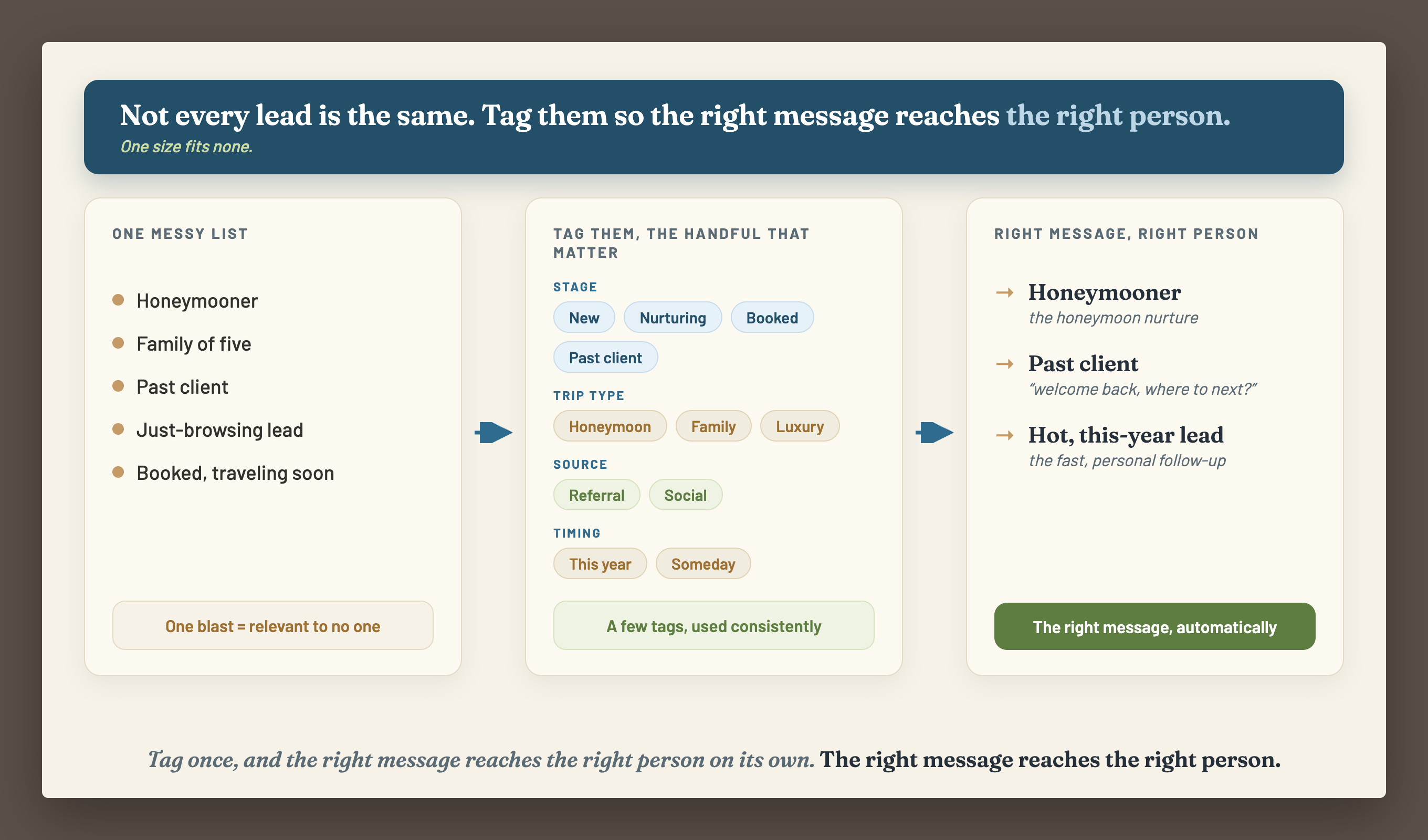
When every lead sits in one undifferentiated pile, you can only do one of two things, and both leak. You go silent, because writing to everyone feels like writing to no one. Or you send one generic blast that is mildly irrelevant to all of them. Segmentation fixes this at the root: when you tag who someone is and what they want, you can finally speak to them like an individual.
A generic message is irrelevant to everyone. Irrelevance is a slow leak. Relevance keeps names warm.
The handful that matter for travel
The tags that matter.
Where they are
Stage
Their place in your pipeline: New, Nurturing, Booked, Past client. Straight from your Manifest in 2.4.
What they want
Trip type
Their niche or dream: honeymoon, family, luxury, the kind of travel they're after.
Where & when
Source & timing
Where they came from and when they travel: referral or social, this year or someday.
Four familiesFour families cover almost everything: where they are, what they want, where they came from, and when.
A few, used well
Don't drown
in tags.
Here is the trap, and it is the same lesson as picking your routes back in 1.6. People discover tagging, get excited, and create fifty hyper-specific tags they will never once use, and the whole system collapses into noise. A small, consistent set of tags you actually apply to every lead beats a sprawling taxonomy you abandon in a week. The goal is not a beautiful filing system, it is the ability to find the right group in three seconds and speak to them.
A few tags you use every time beat fifty you abandon. Consistent beats clever.
Show your screen · set them up
Set them up
in your CRM.
Now make it real in your tool. In a CRM like Tern, you create your short list of tags once, then the only discipline that matters is applying them the moment a lead comes in, right alongside the discovery notes you are already capturing. Tag at intake, while you know the most, and the lead is sorted forever. A minute of tagging at the front door saves you from a messy, unworkable pile at the back. Set the tags up today, then apply them from the very next inquiry on.
Tag at intakeCreate the tags once, then tag at intake, every time. A list you'll tag later is a list you never tag.
This is the whole payoff
Tags drive
the follow-up.
And here is why all of this matters. Tags are not decoration, they are the switchboard for your follow-up. Once people are tagged, you can send the honeymoon nurture only to honeymooners, the warm welcome-back only to past clients, the fast personal reply only to your hot, this-year leads. Each person hears from you about the thing they actually care about, and to them it feels like you remembered them personally. That is what turns a dead list into a living one.
The switchboardTags are the switchboard. Each group hears about the thing they care about, and it feels personal.
Put your second mate to work
More than copy. Your list organizer.
Suggest
Your tag set
It proposes a clean handful of tags built around your niche, so you don't overthink it.
Sort
Tag the backlog
Paste a messy lead list; it suggests the right tag for each so you can catch up fast.
Segment
Find the group
Ask who to message about a deal or idea; it names the exact segment to send it to.
In the libraryCopy-paste example prompts are in the library: How to Prompt Your Second Mate.
Want a hand with this part?
Three ways to get unstuck.
Group
Professor Hours
Bring your specific question to office hours and ask it live.
One-on-one
Book a 1:1
We work on yours, screen to screen, until it's done right.
Done with / for you
Hire us
Consultant or coach. We build it with you, or we build it for you.