Decisions locked (from the whiteboard)
- Closing is not pressure. It's making it easy and natural to say the yes they already want to say. You remove friction, you don't twist arms.
- ★ The yes they already want (the headwind): this beats The Leaky Bucket. Warm leads leak not because they don't want the trip, but because deciding is hard and no one helped. A light, honest nudge is a kindness.
- ★ Tie-downs and gentle agreement (a taste of NLP): small, honest agreement questions ("doesn't that sound perfect?") build momentum to the big yes. Hard ethics rule: only on things they genuinely love. Confirm real agreement, never manufacture it.
- ★ A hundred small yeses, not one big close: reframe the close as a hundred small agreements stacked along the way, each tie-down earning one. Stack enough and the final yes is just the next small step, not a leap. This is the warm, low-pressure way to close. Twenty tie-down tags (isn't it? / wouldn't it? / can't you? / fair enough? ...) live in the new library doc, Tie-Downs and the Hundred Small Yeses, linked from the deck and worksheet.
- ★ Objection handles: the same handful all career ("think about it," "a lot of money," "check with my partner," "I could book it myself"). Most are "not yet," not "no." The handle: acknowledge warmly, reframe gently, ask a question that moves forward.
- ★ Stories sell: facts inform, stories move; a decision is emotional. When they waver, don't add features, tell a true client story that lets them see themselves happy on the other side of yes. Keep a few ready.
- ★ Ask for the booking: the step most skip. Actually invite the decision, plainly and warmly ("shall I get you booked?"), then stop talking. Asking directly is clarity, and clarity is kindness.
- Second Mate (never Co-Pilot) generates honest tie-downs and objection handles, shapes the story, and role-plays a hesitant client. Prompts in the library.
The spine — beat order
Closing is the kind, clear end of a warm conversation, not a pressure tactic. Use honest tie-downs to build agreement, handle the handful of objections calmly (acknowledge, reframe, ask), tell a true story when they waver, and then actually ask for the booking and go quiet. Make the yes easy to say.
- Closing is not pressure
- The yes they already want (the Leaky Bucket)
- Tie-downs and gentle agreement (a taste of NLP)
- A hundred small yeses, not one big close (the twenty tie-downs)
- Objection handles (acknowledge, reframe, ask)
- Stories sell
- Ask for the booking
- The close, step by step (the diagram)
- Put your Second Mate to work
- Your first brick: build your close
- Want a hand? (the hook)
- Into 4.7, Segmentation
The anchor diagram — the close, step by step
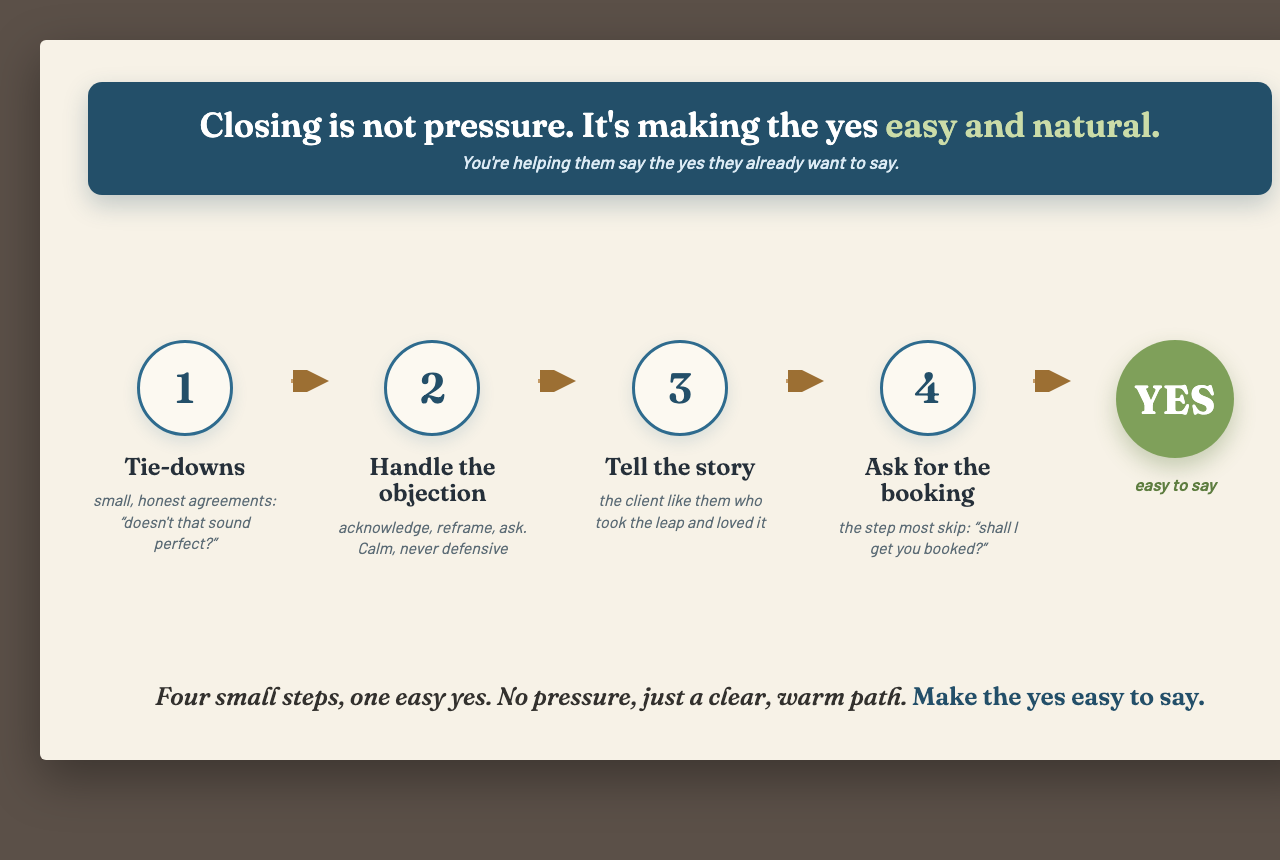
Four small steps, one easy yes. No pressure, just a clear, warm path. Make the yes easy to say.
The objection handle — acknowledge, reframe, ask
The teaching script — Robert's voice
Closing is not pressure
Let us take the scary word, closing, and defang it right now, because I know it makes a lot of you uncomfortable. Closing is not pressure. It is not a slick trick or a hard push. Closing is simply making it easy and natural for someone to say the yes they already want to say. That is it. You are not twisting an arm. You have already done the warm discovery, you have built the dream into a proposal, you have talked money with calm, and this person wants the trip. All closing does is gently remove the small frictions standing between them and the thing they already love. Done right, it is one of the kindest things you can do for a client.
The yes they already want
Here is what happens to so many good advisors. They do everything right, the discovery, the proposal, the calm money conversation, and then they just... stop. They sit back and quietly hope the client will close themselves. And the client almost never does. Not because they do not want the trip, they do, but because deciding is genuinely hard, and you left the door standing ajar instead of warmly walking them through it. That hesitation is the exact leak this entire session exists to plug. So understand it deep in your bones: a light, honest nudge at the end is not being pushy. It is the single most service-minded thing you can do for a person standing right on the edge of a yes.
Tie-downs and gentle agreement
All right, your first light tool, and this is your taste of NLP. A tie-down is just a small, honest agreement question that you weave naturally into the conversation. Doesn't that sound perfect? Wouldn't that be exactly the trip you described to me? That's just what you were hoping for, right? Each one earns a little yes, and those little yeses build a quiet momentum, the two of you nodding along together all the way toward the big yes at the end. Now hear my one firm caution, because it matters to who we are: this only works when it is true. A tie-down on something they genuinely love is rapport, it is connection. A tie-down used to trick someone into agreeing is manipulation, and believe me, people feel it. We use these to confirm real agreement, never, ever to manufacture a fake one.
A hundred small agreements, not one big close
Now let me reframe the whole thing for you, because this is what makes tie-downs feel warm instead of slick. Stop picturing the close as one big dramatic moment, the deep breath, the pitch, the leap you build up to and then spring on someone at the end. That picture is exactly what makes closing feel scary, for you and for them. A real close is not one big yes. It is a hundred small ones, stacked all the way along. Every honest tie-down earns you one of those little yeses. Doesn't that sound perfect, yes. Wouldn't that take the pressure off, yes. You can already picture it, yes. And here is the magic of it: stack enough small yeses and the final yes is not a leap at all. It is just the next small step, the easiest one in the whole conversation, because by then they have already agreed a hundred times that this is right for them. So I want you to keep a handful of these tags in your pocket. Isn't it, wouldn't it, can't you, don't they, fair enough. Twenty of them in the library, with a how-to for each. Scatter them gently on the things they truly love, never stack them in a pushy row, and let each small yes do its quiet work. That is the whole warm, low-pressure way to close.
Objection handles
You are going to hear the very same handful of objections for your entire career, so let us stop fearing them and start preparing them. I need to think about it. It is a lot of money. Let me check with my partner. I could just book it myself. Now, notice something crucial: not one of those is actually a no. Every one of them is a not yet, a quiet request for a little reassurance. And the handle is always the same calm, three-step move. You acknowledge it warmly, so they feel heard. You reframe it gently, offering a new way to see it. And then you ask a question that moves things forward. That makes total sense, and honestly the reason I would hate for you to wait is that the dates we both loved are filling up fast, so, would it help if I held them for you while you and your partner talk it over tonight? Acknowledge, reframe, ask. Have one ready for each.
Stories sell
Facts inform people, but stories move them, and a booking is an emotional decision, never a purely logical one. So when a client is wavering, resist every urge to pile on more features and more bullet points, because more facts almost never tip a feeling. Tell a short, true story instead. I had a couple just like you, they were so nervous about the splurge, and a year later they told me it was the best money they had ever spent in their lives, their kids still talk about that trip at the dinner table. A good story lets your client see themselves on the far side of the yes, already happy, already glad they took the leap. So keep a few real ones in your pocket: one for the hesitant client, one for the budget worry, one for the partner who is not sure yet. The right story at the right moment does what no spec sheet on earth ever could.
Ask for the booking
And now the simplest and most overlooked step in this entire business: you actually have to ask. I cannot tell you how many advisors do every single thing beautifully and then never directly invite the decision. They trail off with a soft let me know your thoughts, and they let the whole warm moment quietly die. Do not skip the ask. Say it plainly and warmly. Shall I get you booked? Are you ready to make this real? Want me to lock it in for you? And then, exactly like in the money conversation, you stop talking and you let them answer. Asking directly is not aggressive, it is clear, and clarity is a genuine gift to someone standing right on the edge of a yes. The ask is the entire point of the close. Never, ever skip it.
Put your Second Mate to work
Real jobs: it generates honest tie-downs and a calm handle for each objection, shapes a real client win into a short moving story, and role-plays a hesitant client so you can rehearse the ask. Copy-paste prompts in the library.
Your Second Mate is a great closing coach, precisely because the close is mostly preparation. Hand it the objections you actually hear and ask it to write you a calm, warm handle for each, acknowledge, reframe, ask. Give it a real client win and ask it to shape it into a short story you can tell in sixty seconds when someone wavers. And the best one, ask it to play a hesitant client and run the close with you, again and again, so the first time you say shall I get you booked out loud, it already feels natural in your mouth. You rehearse with the robot, so you are warm and easy with the human.
Your first brick: build your close
Here is your work, and we do it together. One, draft three of your own honest tie-downs, in your words, on things your clients genuinely love, the twenty in the library will give you the tags to borrow. Two, write down the three objections you hear the most, and a calm acknowledge-reframe-ask handle for each one. Three, choose one true client story that helps a hesitant person picture themselves happily on the other side of yes. Four, write the one warm, direct line you will use to ask for the booking, and then practice the most important part, going quiet right after. Build those few little things, and you will never again do all the hard work of a sale and then freeze at the finish line.
Want a hand with this part?
And if the word closing still makes you cringe, if you have ever talked a client right up to the edge and then chickened out of the ask, or you just want your objection handles to feel natural instead of scripted, please hear me: this is exactly what we are here for. Three doors. Bring your toughest objection to Professor Hours and we will build the handle together, as a group. Book a one-on-one and we will role-play your whole close, tie-downs to the ask, until it feels like you. Or hire us and we will build it with you. You do not have to find your closing voice alone.
Into 4.7, Segmentation
So now you can close, warmly, clearly, with no pressure and no fear. That completes the journey from a fresh lead all the way to a booked client. But here is the thing, not everyone says yes today, and the ones who do are now a different kind of person in your world than the ones still deciding. To follow up with the right message to the right person, your pipeline has to stay clean and organized. That is segmentation, and it is the next session, 4.7. Let us go keep your bucket tidy so nothing slips through.
The deck — slide list
Build-with-you assets — what they finish holding
- The Your Close worksheet — your top three objections and their acknowledge-reframe-ask handles, your one true story, and your direct ask line.
- A Second Mate close kit — honest tie-downs, objection handles, a shaped story, and a hesitant-client role-play.
- Library: Tie-Downs and the Hundred Small Yeses — the twenty tie-down tags with a how-to for each, worked examples, and the hundred-small-yeses reframe. Linked from the deck and the worksheet.
Want a hand?
Professor Hours
Bring your toughest objection and we'll build the handle together.Book a 1:1
We role-play your whole close, tie-downs to the ask, until it's you.Hire us
We build your close with you, handles, story, and ask line.Parking lot — tabled, with a home
Carry these forward
- Keeping your pipeline clean so the right follow-up reaches the right person is 4.7, Segmentation, next.
- Following up with the leads who said "not yet" is a later Confirm/Care beat; this session is the close itself.
- Deeper sales psychology beyond this taste of NLP can live in the Specialty Library, kept always ethical and service-first.
The community move · baked in for the program
Post your one ask line
Drop the single line you'll use to ask for the booking into the group, and let everyone help you make it warmer and more natural. Borrow the ask that sounds easiest to say. Word "closing" still make you cringe? Bring your toughest objection to this week's Professor Hours and we'll build the handle live.
Transition into 4.7
"You can take a warm lead all the way to a yes, with no pressure. Now 4.7, Segmentation: keep your pipeline clean so the right follow-up always reaches the right person."