Decisions locked (from the whiteboard)
- Do not flinch. The moment you flinch about price, so does your client. The number didn't change, your face told them it was too much.
- ★ When you flinch, they flinch (the headwind): this beats The Leaky Bucket. Price is felt as much as heard; a wobble or nervous justifying signals even you aren't sure it's worth it, and a ready client hesitates and leaks.
- ★ Name it, then stop talking: state the price in a full, warm sentence, then go quiet. Don't fill the silence with a discount or disclaimer. The silence feels long to you, normal to them. Don't negotiate against yourself.
- ★ Anchor the budget to the dream (the 4.2 payoff): the dream is the setup, the budget question is the punchline. Once they've painted the unforgettable version, anchor a real range against it: "to make that version real, this kind of trip usually runs between X and Y, does that fit what you had in mind?" The dream answers are what let you ask budget cleanly without breaking the warmth. Not about the money, about making the dream real. Stops proposals getting ghosted.
- ★ Charge for your expertise: not just the trip, for you, your knowing, relationships, the hours saved, the disasters prevented. A fee is valuing yourself; clients respect what's valued. (1.3: charge more, chase less. The fee filters for people who want a pro.)
- ★ Frame against the dream, and the alternative: a number floating alone feels big. Frame it against the dream it buys (the milestone) and the alternative (40 lost hours, booking mistakes). Price shrinks next to value.
- ★ The deposit ask, the next step: not a hurdle, the same clear next step as the proposal. Warm, plain, expectant: "to lock this in, the next step is a deposit of X, I'll send the link." Then stop talking.
- Second Mate (never Co-Pilot) role-plays a price-sensitive client, scripts your deposit ask word for word, and hands you value-framing lines. Prompts in the library.
The spine · beat order
The proposal sold the dream; now you talk money without undoing it. Don't flinch, because the flinch is contagious. Name your price and stop talking. Anchor the budget to the dream they painted, with a real range, so the number serves the dream instead of landing as a cold ask. Charge for your expertise, not just the trip. Frame the number against the dream it buys and the alternative it prevents. Then ask for the deposit as a simple next step. Calm about price means calm about you.
- Do not flinch
- When you flinch, they flinch (the Leaky Bucket)
- Name it, then stop talking
- Anchor the budget to the dream (the 4.2 payoff)
- Charge for your expertise
- Frame against the dream, and the alternative
- The deposit ask (the next step)
- The money conversation (the diagram)
- Put your Second Mate to work
- Your first brick: write your money script
- Want a hand? (the hook)
- Into 4.6, Sales Language and the Close
The anchor diagram · the money conversation
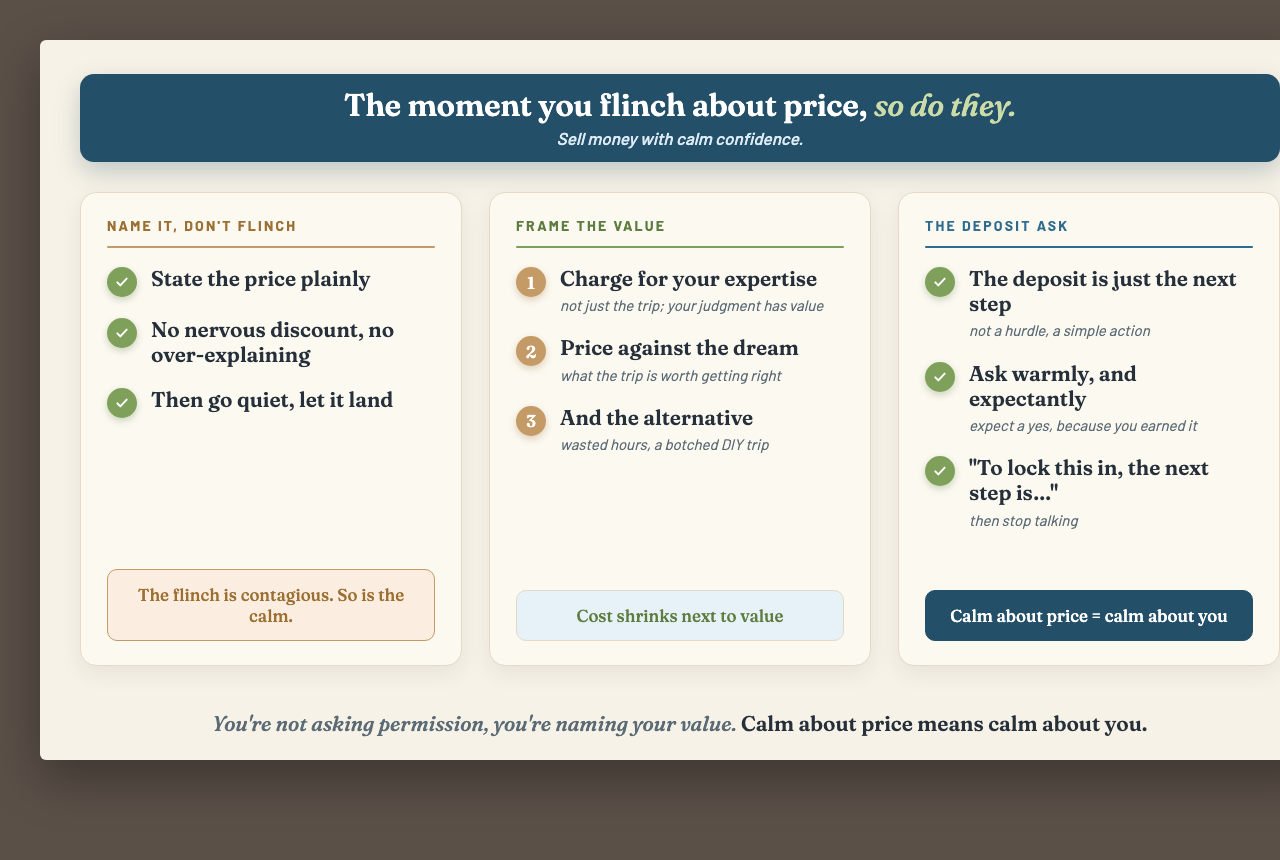
You're not asking permission, you're naming your value. Calm about price means calm about you.
A money script · make it yours, say it out loud
The teaching script · Robert's voice
Do not flinch
All right, this is the one that scares people, so let us walk straight into it. You have done the discovery, you have built a beautiful proposal that sells the dream, and now comes the moment of truth, the money. And here is the single most important thing I can teach you about it: do not flinch. Because the moment you flinch about your price, so does your client. The number on the page did not change, but your nervous face just told them it was too much, and now they believe you. Today we fix that. Today you learn to talk about money with calm, quiet confidence.
When you flinch, they flinch
Understand that price is felt at least as much as it is heard. When you say your number and your voice wobbles, or you rush to soften it, or you start nervously justifying it before the client has said a single word, you have just told them, with your whole body, that even you are not sure it is worth it. And if you, the expert, are not sure, why in the world would they be? That tiny flinch, that little apologetic flicker, is the exact spot where a warm, ready-to-book client suddenly hesitates, says let me think about it, and quietly leaks away. Your calm is not a sales trick. It is the most honest signal you can send that what you are offering is genuinely worth every dollar.
Name it, then stop talking
Here is the entire technique, and it is beautifully simple. You state your price, plainly and warmly, in one complete sentence. And then you stop. You say nothing. You do not fill that silence with a discount, a disclaimer, or a nervous little laugh. Now, that silence after a price is going to feel like an absolute eternity to you, and like a perfectly normal pause to them, so just let it sit there. They are thinking, they are not rejecting you. The advisor who names a number and then keeps talking is negotiating against themselves before the client has even raised an objection. So practice this one until it is pure muscle memory: the price, a period, and a calm, comfortable quiet.
Anchor the budget to the dream
Now here is the move that makes this whole conversation easy, and it starts way back in discovery. Remember how I had you get them to paint the unforgettable version of the trip, out loud, in their own words? That was not small talk. The dream was the setup, and the budget question is the punchline. Once they have described that dream, you anchor the budget right against it, so the number lands in service of the dream instead of dropping out of nowhere as a cold ask. It sounds like this: to make that version real, this kind of trip usually runs between this and that, does that fit what you had in mind? You give them a real range, a genuine X to Y, named warmly and tied straight to the picture they just painted for you. And notice what just happened. You did not interrogate them about money, you connected their dream to a number, and you handed them the easiest possible yes or no. That is the whole reason discovery mattered, the dream answers are exactly what let you ask about budget cleanly without ever breaking the warmth. It is not about the money, it is about making the dream real. Do this, and proposals stop getting ghosted, because you and the client are aimed at the same number before you ever build a thing.
Charge for your expertise
Now let us put a stake through the heart of that old lie that good travel advisors work for free. You are not just charging for the trip itself. You are charging for you. For your years of knowing things. For your relationships. For the dozens of hours you save them. For the quiet disasters you prevent before they ever happen. A planning fee, or a deposit, is not you being greedy, it is you placing a fair value on your own expertise, and here is the thing, clients respect what is valued. Remember session 1.3, charge more and chase less. That fee actually filters for the people who want a real professional, not a search engine with a pulse. The day you truly believe your judgment is worth paying for is the day naming the fee stops being scary and just becomes simple.
Frame against the dream, and the alternative
A price sitting all by itself, floating in the air, always feels big. So you never leave it floating. You frame it against two things. First, the dream it buys. This is the milestone, the once-in-a-lifetime, the memory the whole family is going to tell stories about for the next twenty years. Held up against that, the number is small. Second, the alternative. The forty hours they would lose to research. The booking mistakes. The honeymoon spent on the phone fixing a problem you would have caught in a heartbeat. Price set next to value almost always shrinks. And notice, you are not defending the cost, you are not getting defensive at all. You are simply, calmly reminding them what that number is standing next to.
The deposit ask
And finally, the deposit. Do not treat the deposit like a wall they have to climb over. It is simply the next step, and you ask for it exactly like that one clear next step from your proposal in the last session. Warmly, plainly, and expectantly, because you genuinely do expect a yes here, you earned it. So you say something like: wonderful, to lock this in and get started on the build, the next step is a deposit of this much, and I will send you the link right now. And then, you already know what is coming, you stop talking. Do not apologize for it. Do not soften it. Do not pre-negotiate it in your own head. The deposit ask, delivered with the very same calm as everything that came before it, is the quiet little hinge that turns an interested person into a booked client.
Put your Second Mate to work
Real jobs: it role-plays a price-sensitive client so you can rehearse out loud, scripts your deposit ask word for word, and hands you value-framing lines. Copy-paste prompts in the library.
This is a place where your Second Mate becomes a genuinely useful rehearsal partner, and rehearsal is everything here. Ask it to play the role of a slightly price-sensitive client and run the conversation with you, out loud, so the first time you say your number with a straight, calm face is not in front of a real human being. Ask it to script your deposit ask word for word, in your voice, warm and expectant. And ask it for a few clean lines that frame your price against the dream and the alternative, so they are ready on your tongue. You practice with the robot, so you are calm with the client.
Your first brick: write your money script
Here is your work, and we do it together. One, decide your fee structure, your planning fee or your deposit, and get clear in your own head on what it is for: your expertise. Two, write your deposit ask, word for word, warm and expectant, and write the reminder right next to it to go quiet after. Three, and this is the one that actually matters, say it all out loud, to your Second Mate or to the mirror, until your number rolls off your tongue without a single flinch. A money script you have said out loud ten times is a money script that holds when a real client is staring back at you.
Want a hand with this part?
And if money talk makes your stomach drop, if you have ever discounted yourself the second a client raised an eyebrow, or you just cannot quite say your fee out loud yet without apologizing, please hear me, this is exactly what we are here for, and you are not alone in it. Three doors. Bring your number to Professor Hours and we will practice saying it, calm, as a group. Book a one-on-one and we will role-play your whole money conversation until it is steady. Or hire us and we will build your fee structure and script with you. Nobody should have to find their confidence about price all alone.
Into 4.6, Sales Language and the Close
So now you can talk about money without flinching, you can frame your value, and you can ask for the deposit cleanly. That is huge, that is where most advisors lose the booking. What is left is the gentle art of the words themselves, the language that softly moves a hesitant yes over the line without ever being pushy or salesy. That is the next session, 4.6, Sales Language and the Close. Let us go learn the words that close, kindly.
The deck · slide list
Build-with-you assets · what they finish holding
- The Your Money Script worksheet · your fee structure and what it's for, your deposit ask word for word, and your value-framing lines, ready to say out loud.
- A Second Mate money kit · a price-conversation role-play, a deposit-ask script, and dream-versus-alternative framing lines.
Want a hand?
Professor Hours
Bring your number and we'll practice saying it calm, together.Book a 1:1
We role-play your whole money conversation until it's steady.Hire us
We build your fee structure and money script with you.Parking lot · tabled, with a home
Carry these forward
- The gentle words that move a yes (sales language and the close) is 4.6, next.
- Setting your actual fee and trip pricing ties back to your Peace Number (1.3) and your offer (2.1); this session is the conversation, not the calculator.
- Deposit links and payment setup live in the Specialty Library and your tool (Tern), not in this session.
The community move · baked in for the program
Post your deposit ask, word for word
Drop your deposit ask in the group exactly as you'd say it, and let everyone help you make it warmer and more confident. Read a few others and borrow the calm. Still feel the flinch coming? Bring your number to this week's Professor Hours and we'll rehearse it out loud together.
Transition into 4.6
"You can name your price, frame your value, and ask for the deposit without flinching. Now 4.6, Sales Language and the Close: the gentle words that move a hesitant yes over the line, kindly."