
Marketing Journeys · The Tradewinds Method · Confirm
Session 4.3
The Right
Discovery Questions
Do my questions surface the dream, the budget, and the timeline, without the awkward?
Marketing Journeys4.3The whole skill in four words
Not selling. Not telling.
Not bragging. Asking.
The right question, asked warmly, tells you everything: the dream, the budget, and the timeline, without it ever feeling like an interrogation.
Marketing Journeys4.3 · The Right Discovery QuestionsThe headwind here is the leaky bucket
The right question
does the selling.
A pitch puts people on guard. The second you start telling and selling, they start defending. But a warm, well-aimed question does the opposite: it opens them up, it makes them feel seen, and it hands you the exact information you need to recommend the perfect trip. You are not interrogating and you are not performing. You are asking, with genuine curiosity, and letting their answers do the work. Get the questions right and you rarely have to sell at all, because the right trip will be obvious to both of you.
Pitch and they defend. Ask and they open up. Wrong questions, or none, and the lead leaks away.
Marketing Journeys4.3 · The Right Discovery QuestionsStart here, this is the gold
The
dream questions.
Lead with the dream, always, because it sets the warm tone and it is where the real answers live. You want three or so in your back pocket. The opener that surfaces the why: what would make this trip absolutely unforgettable for you? The one that finds the occasion: what is the real reason behind this one? And the quietly powerful one most advisors forget: what do you not want? Their no's protect you from a wrong recommendation as much as their yes's guide you to the right one. Ask these first, then stay quiet and listen.
What would make it unforgettable? What's the real occasion? What do you NOT want? Then listen.
Marketing Journeys4.3 · The Right Discovery QuestionsThe one everyone fears
The budget question,
without the awkward.
Money feels awkward only when you treat it as awkward. The trick is to frame it as service, not nosiness. So you say: so I do not waste your time showing you things outside what you want to invest, what range are we working in? Now the question is for them. If they hesitate, offer ranges and let them point to one, that is far easier than naming a number cold. And you can lift it from cost to value: what is it worth to you to get this one exactly right? Asked warmly, as a favor to them, the budget question stops being uncomfortable and starts being kind.
Frame budget as service: "so I don't waste your time." Offer ranges. Move from cost to value.
Marketing Journeys4.3 · The Right Discovery QuestionsUrgency and the real decider
Timeline
and decisions.
Two quiet questions here save you weeks of chasing. First, the timeline: when are you hoping to travel, and just as important, when do you need to decide by? That tells you how hot this is and how fast to move. Second, the one almost nobody asks: who else is part of this decision? You can run a flawless discovery with the wrong person and never know why it stalled. Find the real decider early, gently, and bring them into the conversation. Knowing the when and the who is how you stop a warm lead from quietly going cold.
When do you want to go? When must you decide? Who else is part of the call? Ask early.
Marketing Journeys4.3 · The Right Discovery QuestionsThe sheet is a safety net, not a cage
Follow the thread,
not a rigid script.
Here is what separates a real conversation from a survey. Your questions are a safety net so you never forget the essentials, they are not a cage you read from line by line. When a client says something that comes alive, my husband proposed on that beach, we always wanted to take the kids before they grow up, you drop the script and you chase that thread. That is where the booking actually lives. Ask, then truly listen, then let their answer choose your next question. The best discovery sounds like two people talking, not a form being filled.
When something comes alive, chase it. Let their answer pick your next question.
Marketing Journeys4.3 · The Right Discovery Questions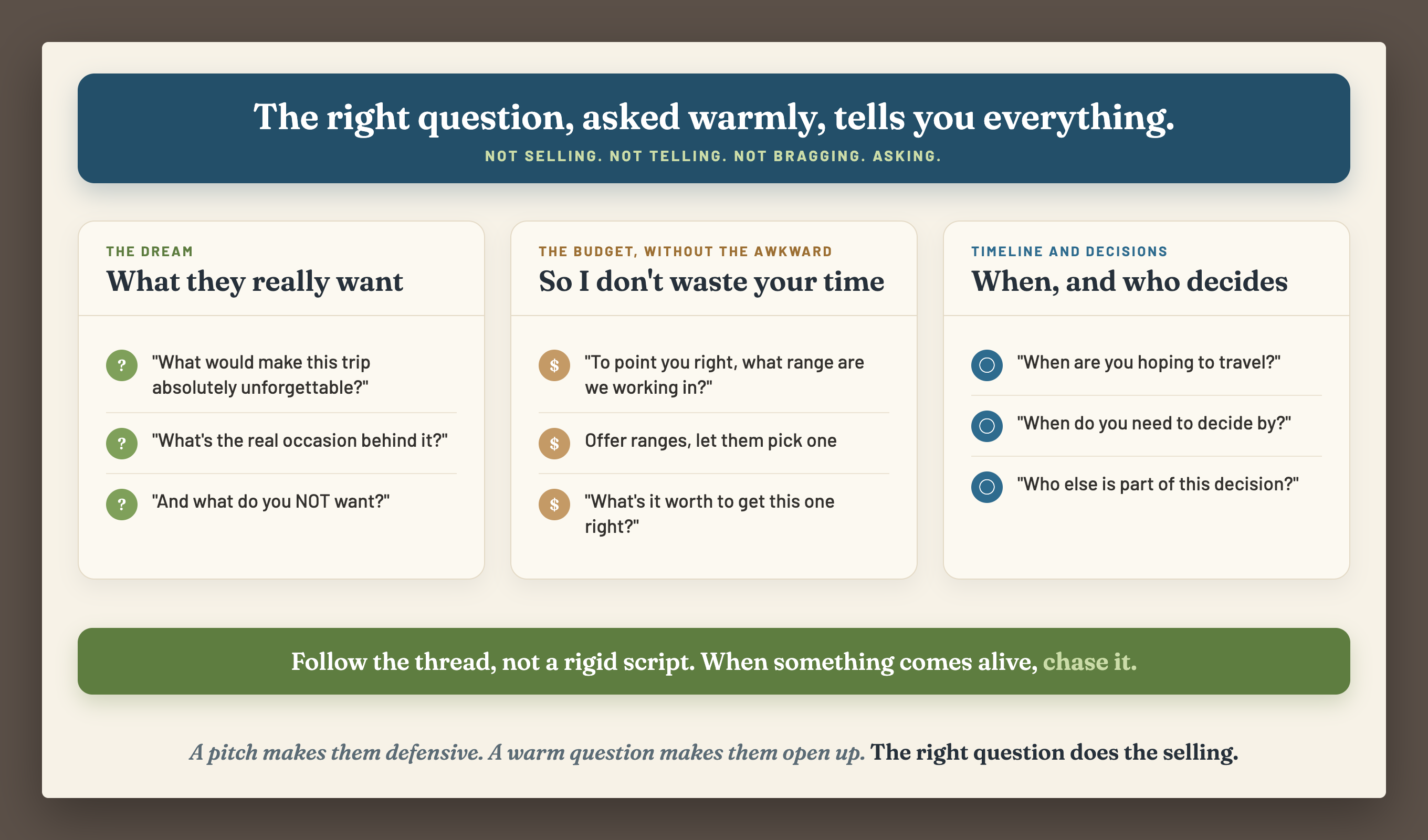
Put your second mate to work
More than copy. Your question coach.
Tailor
To each inquiry
Paste what a lead already told you; it tailors your questions to them, no wasted asks.
Soften
The budget ask
It rewrites your money question three warm ways so it never lands awkward.
Probe
The next thread
It spots the live detail in their answer and suggests the follow-up to chase.
Marketing Journeys4.3 · The Right Discovery QuestionsYour first brick
Write your questions.
1
Your three dream questions
Write the three that surface the why, including "what do you NOT want?" (The Your Questions worksheet.)
2
Your budget question
Write your money question framed as service, plus the ranges you'll offer.
3
Your timeline question
Write your when-and-who-decides question. Three sheets, one warm conversation.
Marketing Journeys4.3 · The Right Discovery QuestionsWant a hand with this part?
Three ways to get unstuck.
Group
Professor Hours
Bring your specific question to office hours and ask it live.
One-on-one
Book a 1:1
We work on yours, screen to screen, until it's done right.
Done with / for you
Hire us
Consultant or coach. We build it with you, or we build it for you.
Marketing Journeys4.3 · The Right Discovery Questions
Built with you, not taught at you
The right question
does the selling.
You can write your dream, budget, and timeline questions today. Asking them warmly, and following the thread live without it feeling like an interrogation, is what we practice together.
We build it with you →
Next → 4.4 · The Proposal — turning what you heard into an offer they say yes to, built in tools like Tern.
Post the one question that's unlocked a booking for you. Questions? Bring them to this week's Professor Hours.
Marketing Journeys4.3