Decisions locked (from the whiteboard)
- The pro asks before they pitch. You don't earn the booking by talking the most, you earn it by understanding them best. Discovery is where the service begins.
- ★ Why discovery wins (the headwind): this beats The Leaky Bucket. You can't recommend a trip until you understand the traveler. Assume instead of ask, guess wrong, and they leak to the advisor who listened.
- ★ It's about them, even if they don't know it yet: under the request (a place, a date, a price) is a dream they can't put into words. Your job is to draw it out, the occasion, the feeling, the who, the why.
- ★ The spectrum, 4 questions to 20: a simple 4-question sheet up to a detailed 20-point questionnaire. You pick the depth and match it to the trip and the client. Don't interrogate a weekend, don't wing a honeymoon.
- ★ Logistics, then the dream: where/when/how-many/how-much are necessary but not enough. Open-ended, about-them questions surface the dream. The exact set (dream, budget, timeline) is all of 4.3.
- ★ The bridge (the real gold): the dream question is the easy win; budget is what advisors choke on and why proposals get ghosted. The dream is the setup, the budget question is the punchline. Once they've painted the unforgettable version, you anchor the number against it: "to make that version real, this usually runs between X and Y, does that fit?" It keeps the warmth because it's about making the dream real, not the money. Teased here, taught fully in 4.5, The Money Conversation.
- ★ Listen, note, reflect back: talk less than they do, note their words in Tern (your Manifest from 2.4) so nothing is lost, then say "so what I'm hearing is..." Feeling understood is what earns the booking, and because it's logged you can reflect it back later too.
- Second Mate (never Co-Pilot) drafts your questionnaire, turns raw answers into a clean trip brief, and suggests deeper follow-ups. Prompts in the library.
The spine - beat order
Discovery is the conversation that earns the booking. You ask before you pitch, because you can't recommend until you understand. It's about them, even if they don't yet know what they want, so you draw out the dream under the request. Pick your depth on the spectrum, favor open-ended questions over logistics, and see the real gold: the dream answers are the bridge that let you ask about budget cleanly (the setup and the punchline, teased here, taught in 4.5). Then listen, note it in Tern, and reflect it back.
- The pro asks before they pitch
- Why discovery wins (the Leaky Bucket)
- It's about them, even if they don't know it yet
- The spectrum: 4 questions to 20
- Logistics, then the dream (the shape of a good question)
- The bridge: the dream is the setup, the budget is the punchline (tease, full in 4.5)
- Listen, note, reflect back (note it in Tern, reflect it back later)
- The discovery conversation (the diagram)
- Put your Second Mate to work
- Your first brick: build your discovery sheet
- Want a hand? (the hook)
- Into 4.3, The Right Discovery Questions
The anchor diagram - the discovery conversation
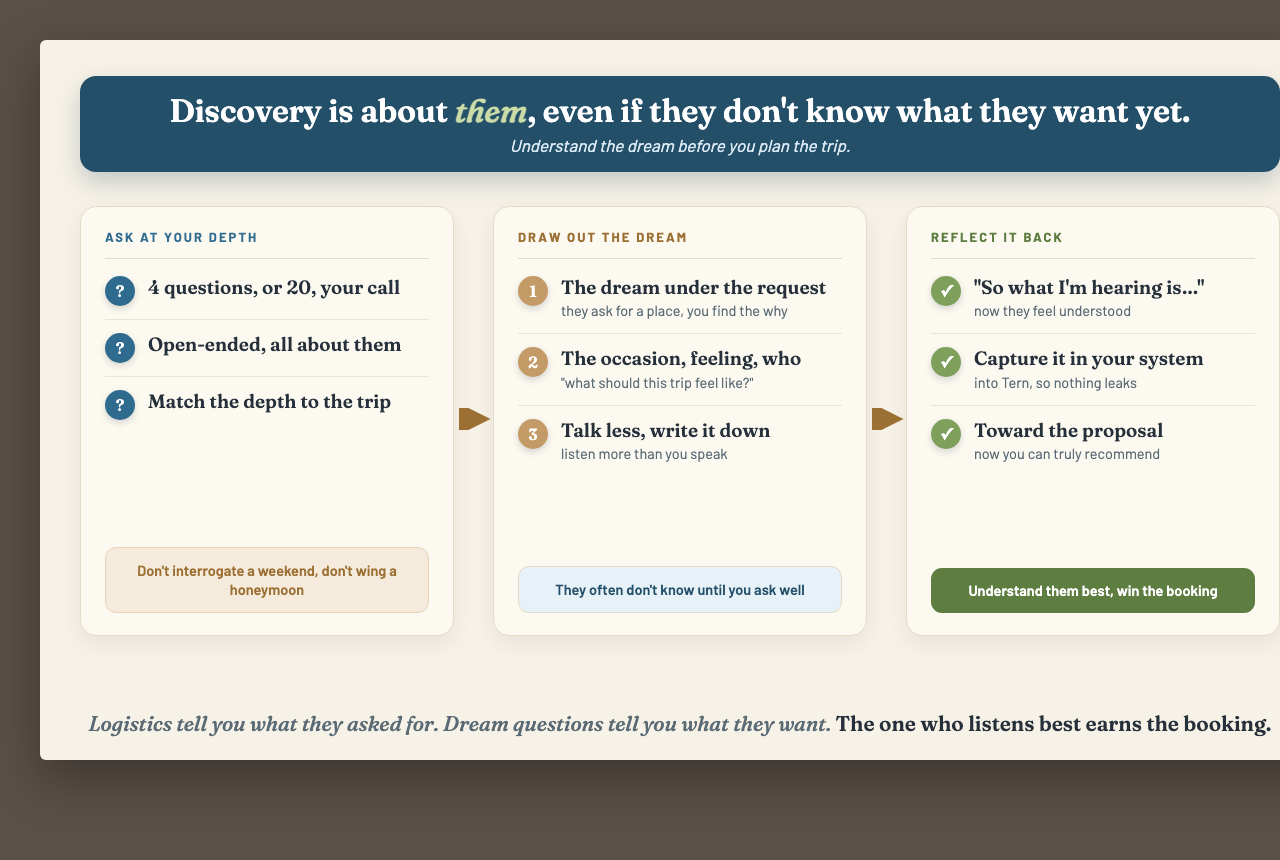
Logistics tell you what they asked for. Dream questions tell you what they want. The one who listens best earns the booking.
The teaching script - Robert's voice
The pro asks before they pitch
Let me tell you the single biggest difference between the advisor who scrapes by and the advisor who books beautiful, loyal clients. It is not the destinations they know. It is not their supplier list. It is that the pro asks before they pitch. The amateur hears "I want to go to Italy" and immediately starts selling Italy, hotels, tours, the whole thing. The pro leans back and gets curious. Because here is the truth: you do not earn the booking by talking the most, you earn it by understanding them best. Discovery is not the polite chit-chat before the real work starts. Discovery is the real work.
Why discovery wins
You simply cannot recommend the right trip until you understand the traveler in front of you, it is impossible. And the moment you skip the asking and start assuming, you are guessing. Maybe you guess right now and then, but a guess that misses tells that client, loud and clear, that you were not really listening to them. So what do they do? They drift, quietly, to the advisor who was. That is the leak, right there, and it is the whole reason this part of the course exists. Every great recommendation you will ever make is born here, in you understanding someone so well that the perfect trip becomes obvious. Do the discovery, and you stop guessing for good.
It's about them, even if they don't know it yet
Now here is the heart of the whole thing, so lean in. A client comes to you and asks for a place, a date, a price. But that is almost never what they actually want. Underneath that request is a dream they usually cannot put into words yet. There is an occasion they are quietly marking. A feeling they are chasing. A person they are really doing this for. A why. Your job is not to take their order like a waiter. Your job is to gently draw that dream out, with good questions, until they hear themselves say the very thing they did not even know they were looking for. And I promise you, that exact moment, when they feel you see what they could not name, that is the moment they decide you are the one.
The spectrum: 4 questions to 20
So how much do you ask? It is a spectrum, and you get to choose where you sit on it. On one end, a simple four-question sheet, fast and warm, plenty for a straightforward trip or a first conversation, and it never makes the client work too hard. On the other end, a detailed twenty-point questionnaire that paints the full picture for a honeymoon, a milestone anniversary, a complex multi-stop dream where every detail matters. Neither one is more professional than the other. The skill is matching the depth to the trip and the client in front of you. Do not interrogate someone over a long weekend. And do not wing a honeymoon. Pick your depth on purpose.
Logistics, then the dream
And a quick word on the kind of question, because this matters. There are logistics questions, where, when, how many, how much, and yes, you need every one of them. But understand: anyone can ask those, and on their own they tell you nothing about the dream. The open-ended question is the other kind, the one that is all about them. What should this trip feel like? What would make it absolutely unforgettable for you? You ask those, then you go quiet and you listen for the why underneath the answer. Next session, 4.3, I am going to hand you the exact set, the dream questions, the budget question without the awkwardness, the timeline questions. Today, just feel the difference between asking about the trip and asking about them.
The dream is the setup. The budget is the punchline.
The real gold is not the dream question. It is the bridge from the dream to the money, without breaking the warmth.
Now, here is the part nobody puts on the slide, so let me put it on this one. The dream questions are the easy win. The part that makes advisors sweat, the real reason a proposal goes out and then just gets ghosted, is the money. Nobody wants to ask about budget. But watch what the dream gives you. Once the client has painted the unforgettable version out loud, with their own mouth, you have earned the right to anchor a number against it, gently. "To make that version real, this kind of trip usually runs between X and Y, does that fit what you had in mind?" Feel that? The dream is the setup. The budget question is the punchline. It never breaks the warmth, because it is not about the money, it is about making their dream real. I am only teasing it here. We drive the whole money conversation home, asking that number without flinching, in 4.5. For today, just see that the dream answers are exactly what let you ask about budget cleanly.
Listen, note, reflect back
Talk less than they do. Note their exact words in Tern. Reflect it back, then reflect it back again later, with nothing lost.
Asking is only half the skill. What you do with the answers is the other half, and it is where trust is actually built. So, talk less than they do, far less, and note what they say in Tern, their words, not your tidy summary of their words, so not one thing is lost. Then, and this is the magic move, reflect it back to them. "So what I am hearing is, you want the kids exhausted and happy every night, and one quiet dinner, just for the two of you." When a client hears their own dream said back to them clearly, they feel understood in a way that almost nobody in their life makes them feel. That feeling is what earns the booking, more than any itinerary. And because every word of it is logged in Tern, your Manifest from 2.4, you can reflect it back later too, in the proposal, on the next call, every time, with not a single detail slipped through.
Put your Second Mate to work
Real jobs: it drafts a niche-tailored questionnaire at your depth, turns raw answers into a clean trip brief, and suggests the deeper follow-ups worth asking. Copy-paste prompts in the library.
Your Second Mate is a genuine partner in this. Have it draft a discovery questionnaire tailored to your niche, at whatever depth you chose, so you are not staring at a blank page. Then, after a discovery call, paste in the client's raw, messy answers and ask it to organize them into a clean trip brief you can actually plan from. And here is a sharp one, give it what the client said and ask it to suggest the one or two deeper questions still worth asking this particular person. It helps you listen better, not less.
Your first brick: build your discovery sheet
Here is your work, and we do it together. One, pick your depth, decide where you sit on the spectrum, a tight four-question sheet or a fuller set. Two, write the one open-ended dream question you will always, always ask, the one that surfaces the why. Three, plan your reflect-back, decide how you will capture their answers and say them back, and where you will store it, which is Tern. Do that, and you walk into your next inquiry with a real instrument in your hand instead of a hope that you will remember to ask the right things.
Want a hand with this part?
And if you have never built a discovery sheet, or yours feels more like a form at the dentist than a warm conversation, or you freeze on the live call and forget to dig, this is exactly what we are here for. Three doors. Bring your draft questions to Professor Hours and we will warm them up together. Book a one-on-one and we will build your whole discovery instrument and role-play a real call, side by side. Or hire us and we will build it with you. You should never wing the most important conversation you have with a client.
Into 4.3, The Right Discovery Questions
So now you understand the why, that discovery is about them, and you have the shape of your instrument. What you want next, of course, are the actual words, the exact questions that surface the dream, the budget, and the timeline without it ever feeling like an interrogation. That is the whole of the next session, 4.3, The Right Discovery Questions. Let us go fill your sheet with questions that do the work for you.
The deck - slide list
Build-with-you assets - what they finish holding
- The Your Discovery Questions worksheet - your chosen depth on the spectrum, your one always-ask dream question, and your plan to capture and reflect back into Tern.
- A Second Mate discovery kit - a niche-tailored questionnaire, a paste-to-brief prompt, and a deeper-follow-ups prompt.
Want a hand?
Professor Hours
Bring your draft questions and we'll warm them up together.Book a 1:1
We build your discovery instrument and role-play a real call.Hire us
We build your discovery system with you, sheet to reflect-back.Parking lot - tabled, with a home
Carry these forward
- The exact questions (dream, budget without the awkward, timeline, follow the thread) are 4.3, The Right Discovery Questions, next.
- The full budget conversation (asking the number without flinching, the bridge from the dream to the money) is 4.5, The Money Conversation. We only tease it here.
- Turning the brief into a proposal that gets a yes (built in tools like Tern) comes in 4.4.
- Tern setup deep-dives live in the Specialty Library and back in 2.4, not in this session.
The community move · baked in for the program
Post your one dream question
Drop the single open-ended dream question you'll always ask into the group, and borrow three you love from everyone else. The best discovery questions spread fast in a room full of advisors. Nervous about the live call? Bring it to this week's Professor Hours and we'll role-play it.
Transition into 4.3
"You understand why discovery wins, and you have the shape of your instrument. Now 4.3, The Right Discovery Questions: the exact words that surface the dream, the budget, and the timeline, without the interrogation."