Decisions locked (from the whiteboard)
- People you haven't met yet. 3.5 was the people you already know; this route is the people you don't, yet. Another sail toward your peace number.
- ★ Find the right rooms, two not ten. Where your person (or the people who refer them) already gathers, online (niche groups, LinkedIn, virtual summits) and off (BNI, the Chamber, charity galas, alumni mixers, local meetups). Two worked beats ten visited once.
- ★ Relationships, not cards (the headwind). This beats The Vanity Trap. A pile of cards is a vanity metric. Trade it for three real conversations. Be curious, not transactional; look for ways to be useful.
- ★ Now you see where the elevator pitch comes in. Your spoken pitch from 3.2 is your intro, in person, when someone asks what you do. This is the room you built it for.
- The question that opens it. Be interested, not interesting. One good opener that gets them talking about themselves. Your pitch comes second, after you've listened.
- ★ The money is in the follow-up. A hello is worth nothing until you follow up, within 48 hours, with a personal note that references the real conversation, a little value, and a soft invite to your list.
- Second Mate (never Co-Pilot) preps your intro and opener questions, suggests rooms, and drafts the personal follow-up from your notes. Prompts in the library.
The spine — beat order
Networking isn't collecting cards, it's starting relationships then following up so they don't fade. Find two right rooms, work them with curiosity instead of a pitch, use your spoken intro when asked, and follow up within 48 hours so a hello becomes a lead. The money is in the follow-up.
- Not collecting cards, starting relationships
- Find the right rooms (two, not ten)
- Relationships, not cards (the Vanity Trap)
- Your intro, out loud (the 3.2 pitch in action)
- The question that opens it
- The follow-up that converts
- Networking, end to end (the diagram)
- Put your Second Mate to work
- Your first brick: pick two rooms
- Want a hand? (the hook)
- Into 3.7
The anchor diagram — networking, end to end
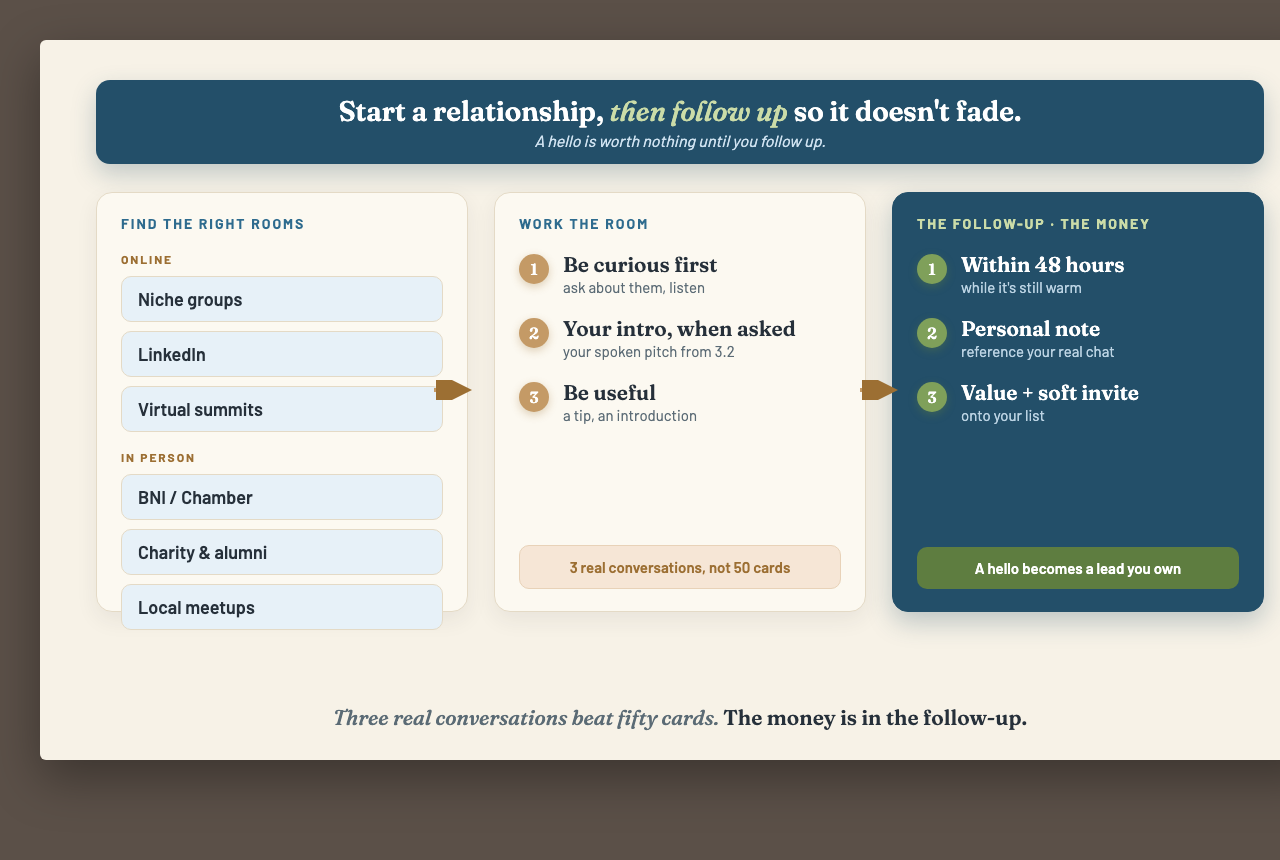
Right rooms, then three real conversations, then the follow-up. The follow-up is where a hello becomes a lead you own.
The teaching script — Robert's voice
Not collecting cards, starting relationships
Let me clear up what networking actually is, because most people get it exactly wrong. Networking is not collecting business cards. It is not working a room like a vending machine, shaking as many hands as you can and walking out with a stack of contacts you will never speak to again. Networking is starting relationships, real ones, with people you have not met yet, and then following up so those relationships do not fade. 3.5 was about the people who already know you. This is about everyone else, and done right, it is one of the warmest routes there is.
Find the right rooms
It starts with picking the right rooms, and notice I said rooms, not every room. You do not need to be everywhere, you need to be where your person already gathers, or where the people who refer your person gather. And those rooms live in two worlds. Online, that is niche groups, LinkedIn, virtual summits, wherever your people talk. And in person, that is BNI, the Chamber of Commerce, charity galas, alumni mixers, local meetups. Pick two, one of each ideally, that you can show up in again and again. Because two rooms you actually work, where people start to know your face, beats ten rooms you breezed through once.
Relationships, not cards
Now here is the headwind in this room, and it is the Vanity Trap again. It whispers, win the night, collect fifty cards, hand out a hundred of yours. And a stack of cards feels so productive. But it is a vanity metric, it does absolutely nothing, those cards go in a drawer and die. So trade the whole numbers game for three real conversations. Three. Be curious instead of transactional. Ask about them. And look for ways to be genuinely useful, an introduction you could make, a tip, a connection. You are not in that room to sell. You are there to start something. The selling, if it ever happens, comes much later.
Your intro, out loud
And now, finally, you see where that spoken pitch from 3.2 comes in. Because somebody is going to ask you, what do you do? And this is the exact moment you built that pitch for. You do not say I'm a travel agent and watch their eyes glaze. You say what you do for people. I take the time and the stress out of planning the trip of a lifetime, so my clients just show up and enjoy it. Short, warm, and it makes them lean in and go, oh, tell me more. You already wrote it and practiced it. The room is where it earns its keep.
The question that opens it
But here is the subtle part, do not lead with your pitch, lead with curiosity. The fastest way to be interesting to someone is to be interested in them. So walk in with one good opener ready, a question that gets them talking about themselves. What brought you here tonight? What are you working on these days? People will forget your clever line about yourself, but they will remember how you made them feel, and feeling genuinely heard is rare and magnetic. Listen first. Your pitch comes second, after they have had their turn.
The follow-up that converts
And now the single most important thing in this entire session, the thing almost nobody actually does. The money is in the follow-up. A wonderful conversation at an event is worth precisely nothing if you never follow up. So you do, within a day or two while it is still warm, with a personal note that references your actual conversation, not a copy-paste blast, an actual detail you talked about. You remind them who you are, you give a little value, and you softly invite them onto your list. That, right there, is the hinge. That is how a handshake at a mixer becomes a lead you actually own.
[Robert, your story here] This is the natural spot for your real story of a connection that became a client, a specific person you met, and the follow-up that turned it into work. Keep it true and specific. (Per the no-invented-stories rule, the deck leaves this slot for your own.)
Put your Second Mate to work
Real jobs, not just rewriting: it sharpens your intro and opener questions, suggests rooms where your person gathers, and drafts a warm, personal follow-up from your conversation notes. Copy-paste prompts in the library, How to Prompt Your Second Mate.
Your Second Mate is a great wingman for this. Before the event, have it sharpen your intro and hand you five natural opener questions so you are not scrambling. Ask it to suggest the online and local rooms where your person actually gathers. And the next morning, the part everyone dreads, feed it your quick notes, met so-and-so, we talked about this, and have it draft a warm, personal follow-up you can tweak and send. It removes every excuse not to follow up.
Your first brick: pick two rooms
Here is your work, and we do it together. Pick two rooms, one online and one off, where your person gathers and you can keep showing up. Bring your intro line, your spoken pitch from 3.2, plus one opener question. And decide your follow-up plan before you ever walk in, how and when you will reach back out. Do that, and a night of small talk turns into real leads on your list.
Want a hand with this part?
And if walking into a room of strangers makes your stomach drop, or you always mean to follow up and never do, this is exactly what we are here for. Three doors. Bring your two rooms to Professor Hours and we will rehearse your intro live. Book a one-on-one and we will build your whole game plan, opener to follow-up, together. Or hire us and we will set the system up with you. You never have to walk in cold and alone.
Into 3.7
So you can find a room and work it. But there is something even more powerful than walking into someone else's room, and that is having a room of your own, a place where your people gather around you. So next, we go from attending communities to building or joining one. That is where this all compounds.
The deck — slide list
Build-with-you assets — what they finish holding
- The Your Rooms worksheet — two rooms (one online, one off), your intro line and opener question, and a written follow-up plan.
- A Second Mate-prepped kit — a sharpened intro, five opener questions, suggested rooms, and a drafted personal follow-up.
Want a hand?
Professor Hours
Bring your two rooms and we'll rehearse your intro live.Book a 1:1
We build your game plan, opener to follow-up, together.Hire us
We set up your networking and follow-up system with you.Parking lot — tabled, with a home
Carry these forward
- Having a room of your own (building or joining a community) is next, 3.7.
- Becoming top of mind (carpet-bomb vs spend vs surgical) is its own session, Getting Found, later in the routes arc.
- The advisor as the connector (local go-to person) lands around 3.7 or 3.8, and it grows straight out of being useful in rooms.
The community move · baked in for the paid program
Name your two rooms
Post the two rooms you'll show up in this month, one online, one off. Saying it makes you go. And if a room makes you nervous, say so, someone here has worked it and will tell you what to expect. Stuck on which rooms? Bring it to this week's Professor Hours.
Transition into 3.7
"You can find a room and work it. Even better than attending someone else's room is having one of your own, a place where your people gather around you. That's next: building or joining a community."